48V Battery For Ebike Explained: A UK Buyer's Guide
Key Takeaways
- A 48V battery for ebike use offers a strong balance of torque, speed support and range for many UK riders, especially commuters and leisure cyclists covering mixed terrain.
- Battery capacity matters as much as voltage: a 48V 13Ah pack stores about 624Wh, while a 48V 20Ah pack stores about 960Wh.
- Before buying, check motor compatibility, controller voltage, connector type, mounting rail, charger specification and BMS protection.
- For UK buyers, safety and legal compliance matter. A road-legal EAPC in the UK must have a motor with a maximum continuous rated power of 250W and assistance cutting off at 15.5mph (25km/h) (GOV.UK).
- If you want the wider battery landscape first, read our Ultimate Guide to Electric Bike Batteries 48V in the UK.
A good battery can transform an electric bike from frustrating to dependable. If your current pack is fading, your range has dropped in cold weather, or you’re building an ebike from parts, choosing the right 48V battery for ebike use is one of the most important buying decisions you’ll make.
We’ve worked through the questions UK riders ask most often: how far a 48V pack can go, whether it’s legal, what size you need for commuting, and how to avoid buying a battery that doesn’t fit your motor, rail or charger. This guide stays tightly focused on 48V packs so you can buy with confidence, whether you ride into the city five days a week or need extra support on steep rural roads.
At Eifduhp Power, our wider mission is simple: Power Your Commute with a 72v Ebike Battery Built for Britain. That same safety-first, practical approach applies when choosing a 48V system too — high-capacity lithium-ion performance, dependable BMS protection and easy-fit installation matter at every voltage.
What is a 48V battery for ebike use?
A 48V ebike battery is a lithium-ion battery pack designed to supply a nominal voltage of 48 volts to an electric bike system. In practical terms, that voltage affects how the bike delivers power, especially under load. Riders often notice stronger hill support and brisker acceleration compared with lower-voltage systems, assuming the motor and controller are matched correctly.
Most 48V packs are built from multiple lithium-ion cells arranged in series and parallel. A typical 48V lithium-ion battery is often charged up to around 54.6V when full, which is why charger compatibility is critical. The battery will also include a Battery Management System (BMS) to monitor charging, discharging, temperature and cell balance.
If you’re new to ebike electrics, voltage is only part of the picture. Capacity, measured in amp-hours (Ah), and total energy, measured in watt-hours (Wh), are just as important. For a broader foundation, our 48V electric bike battery guide for the UK explains how voltage, capacity and fitment work together.
48V, Ah and Wh explained simply
When comparing one 48V battery with another, use this basic formula:
Volts (V) x Amp-hours (Ah) = Watt-hours (Wh)
- 48V 10Ah = 480Wh
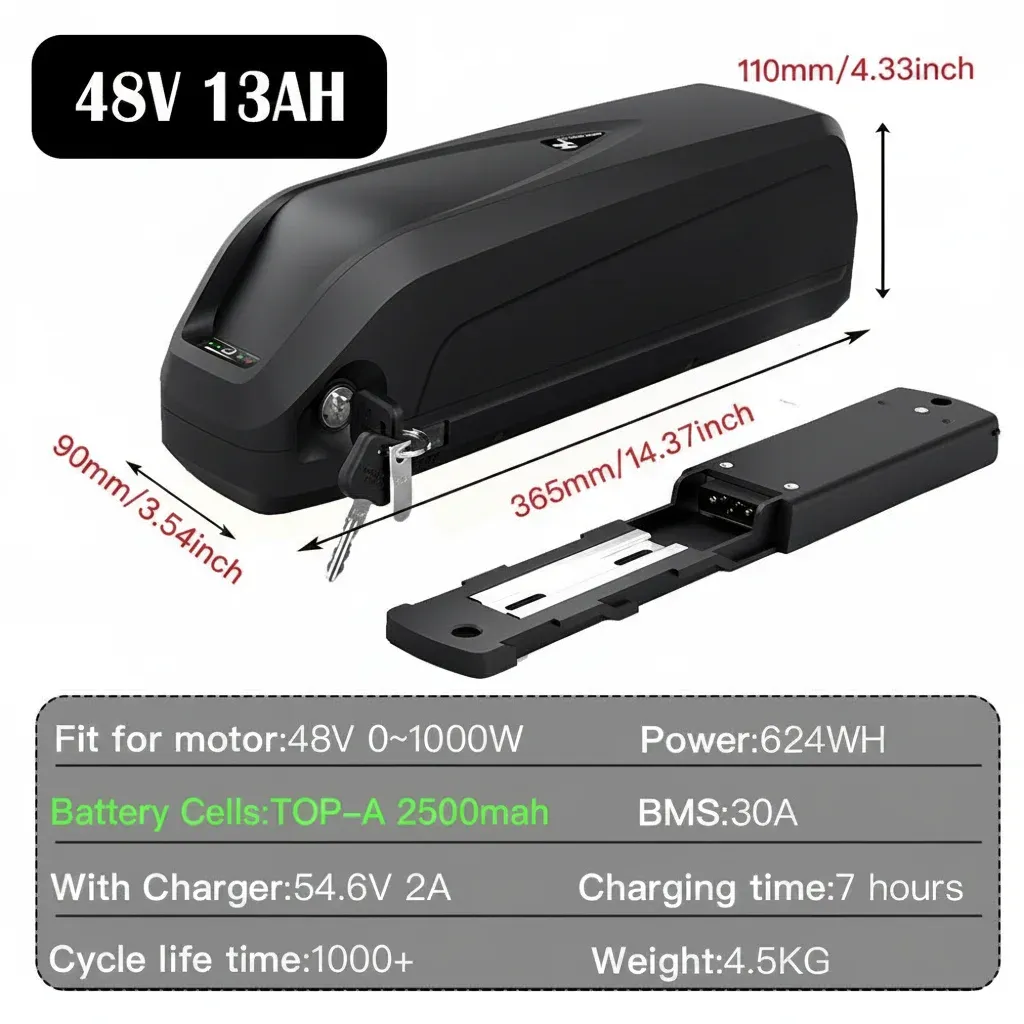
- 48V 13Ah = 624Wh
- 48V 15Ah = 720Wh
- 48V 20Ah = 960Wh
That Wh figure gives you a more useful way to compare real-world energy storage. A 48V 13Ah battery, for example, stores around 30% more energy than a 48V 10Ah pack.
Why UK riders choose a 48V battery for ebike setups
For many British riders, 48V hits a practical sweet spot. It suits urban commuting, hilly suburban routes and weekend leisure rides where you want stronger assistance without stepping into specialist high-voltage territory.
UK roads and cycle routes are rarely uniform. A daily journey might include stop-start junctions, rougher road surfaces, headwinds, wet weather and short sharp climbs. A 48V system can feel more assured in these conditions than lower-voltage alternatives, especially on heavier bikes carrying panniers, locks, work kit or shopping.
Better support on hills and under load
If you ride in places like Bristol, Sheffield, Bath or the hillier edges of London, a 48V battery can help a compatible motor maintain stronger output on climbs. That doesn’t mean every 48V bike is faster or better, but it often means less strain when the bike is loaded or the route is steep.
Useful for commuting and utility cycling
The UK government reports that 43% of people aged 5 and over in England cycled at least once a year in the year ending March 2024, while 7% cycled at least once a week (Department for Transport). That mix includes commuters, occasional riders and people using bikes for short local journeys. For riders moving from occasional use to regular utility cycling, battery reliability becomes central.
A 48V pack is often chosen by commuters who want a dependable reserve rather than running a smaller battery close to empty every day. In our experience, that can be a smarter long-term choice in Britain’s colder months, when range tends to dip.
Range confidence in mixed British weather
Cold temperatures, strong winds and repeated starts all reduce range. A battery that looks ample on paper can feel undersized by January. That’s why many UK buyers prefer a 48V battery with enough watt-hours to leave headroom rather than chasing the smallest, lightest or cheapest option.
How far can a 48V battery for ebike riding go?
Range depends on the total watt-hours in the battery and how much energy your bike uses per mile. On a typical UK commuter or hybrid ebike, energy consumption may vary from roughly 10Wh to 20Wh per mile, sometimes more on steep hills, in winter or with high assist.
Using that rule of thumb:
- 48V 13Ah (624Wh): around 31 to 62 miles
- 48V 15Ah (720Wh): around 36 to 72 miles
- 48V 20Ah (960Wh): around 48 to 96 miles
Those are broad estimates, not promises. Real-world mileage changes according to rider weight, tyre pressure, motor efficiency, road surface, outside temperature, wind, luggage and how often you rely on the highest assist level.
What affects 48V battery range most?
- Battery capacity — more Wh usually means more range.
- Assist level — high assist drains the pack much faster.
- Terrain — steep gradients increase energy use sharply.
- Rider and cargo weight — heavier loads demand more power.
- Temperature — winter conditions reduce usable performance.
- Tyres and maintenance — under-inflated tyres and rubbing brakes waste energy.
A practical UK commuting example
If your round trip is 18 miles a day and your bike averages 14Wh per mile, you’ll use around 252Wh daily. A 48V 13Ah battery at 624Wh gives a healthy reserve, helping reduce range anxiety and avoiding constant full discharge cycles. That reserve is particularly useful if your route changes, you carry shopping on the way home, or you ride in colder weather.
How to choose the right 48V battery for ebike compatibility
The biggest mistake UK buyers make is assuming any 48V battery will work with any ebike. It won’t. Voltage must match, but so must the controller, connector, mounting style and charger requirements.
Check motor and controller voltage first
If your ebike system is designed for 48V, use a 48V battery. Fitting the wrong voltage can damage electronics, trigger faults or create safety risks. Look at the motor label, controller label or original bike documentation. If the bike currently runs on 36V, don’t upgrade to 48V unless the whole system is designed to accept it.
Match the discharge capability to the bike’s demand
Not all 48V batteries deliver the same continuous current. A commuter motor with modest demand may be fine with a lower continuous output, while a more demanding setup needs a battery and BMS rated to handle higher current safely. If the current rating is too low, the battery may cut out under load or age prematurely.
Confirm the mounting rail and physical dimensions
Case shape matters. Common ebike battery styles include down-tube, rear rack and integrated frame designs. Measure the available space in millimetres and compare the lock rail, fixing points and case profile before ordering. Even a small mismatch can stop the battery seating properly.
Inspect the connector type
Connector incompatibility is another frequent issue. Check whether your battery uses the same discharge connector and charging port as your current system. Never force a connection or rely on poor-quality adapters unless they are specified by a competent supplier.
Use the correct charger
A 48V lithium-ion battery typically needs a charger output of 54.6V. Using the wrong charger can shorten battery life or create a safety hazard. If you need a deeper look at charging specifications, read our 48V ebike battery charger guide.
What battery capacity should you buy?
The right size depends on your route, rider weight, assist level and how much buffer you want. Buying too small often ends up costing more, because you charge more often and place greater stress on the pack.
48V 10Ah to 13Ah: light commuting and shorter trips
This size suits lighter riders, flatter routes and shorter daily mileage. It can work well for a 5 to 10 mile each-way commute if you charge regularly and don’t rely on maximum assist all the time. Eifduhp’s 13Ah format is a practical middle ground because it adds useful range without becoming excessively bulky.
48V 15Ah: balanced everyday option
For many UK riders, 15Ah is the sensible all-round choice. It offers stronger range for mixed terrain and leaves more reserve for winter commuting. If your route includes hills, traffic starts and occasional diversions, this capacity is often worth the extra upfront cost.
48V 20Ah and above: longer range and heavier use
If you ride longer distances, tow cargo, carry heavy panniers or simply want fewer charge cycles, 20Ah can make sense. The trade-off is extra weight and a larger case, so always check frame space and handling implications.
Should you consider 52V instead?
Some buyers compare 48V and 52V systems when planning a replacement or upgrade. That only makes sense if the rest of the electrical system is compatible. If you’re weighing up the differences, our UK guide to 52V ebike batteries explains where 52V fits and when it doesn’t.
Safety, quality and UK buying checks
A battery is not the place to cut corners. Cheap, poorly assembled packs can fail early, deliver inconsistent performance or create serious safety risks. We recommend looking beyond headline voltage and price.
Look for BMS protection
A proper Battery Management System helps protect against over-charge, over-discharge, over-current and short circuit conditions. Safety-first BMS protection is one of the clearest signs that a battery is designed for real-world reliability rather than just a low sticker price.
Check cell quality and build consistency
Ask what type of lithium-ion cells are used, what the pack capacity is in Wh, and whether the casing and mounting hardware are suitable for repeated road vibration. On British roads, with potholes, kerbs and wet-weather use, build quality matters.
Review UK consumer protection
When buying from a UK retailer, your purchase is supported by consumer protections including the Consumer Rights Act 2015. You should also check returns terms, warranty coverage and whether support is available from a UK-based seller.
Know the legal context for road use
Battery voltage alone does not determine legality. In the UK, an Electrically Assisted Pedal Cycle must still meet the rules on motor rating and assisted speed. GOV.UK states that compliant EAPCs must have pedals, a motor with a maximum continuous rated power of 250 watts, and electrical assistance that cuts off at 15.5mph (GOV.UK electric bike rules).
If your bike is intended for public roads, cycle lanes and shared-use paths, always make sure the complete setup remains compliant.
Charging and caring for a 48V battery in Britain
Battery care has a direct effect on lifespan. In UK conditions, damp garages, cold sheds and irregular commuting patterns can all shorten service life if you don’t store and charge the pack properly.
Best charging habits
- Use the charger specified for your 48V battery.
- Charge indoors in a dry, ventilated area away from exits and combustible materials.
- Let the battery cool before charging if it has just been used hard.
- Don’t leave it fully flat for long periods.
- If storing the battery, keep it partially charged rather than empty.
Cold weather storage tips
In winter, don’t leave the pack in an unheated outbuilding for weeks on end. Low temperatures can reduce performance and make the battery feel weaker than it is. For best results, store it in a cool, dry indoor environment and fit it to the bike shortly before riding.
When to replace a 48V battery
Common signs include reduced range, voltage sag under load, charging faults, excessive heat or intermittent cut-outs. If your battery no longer holds enough charge for your normal commute, replacement is often more practical than trying to work around it daily.
For a wider overview of battery lifespan, charging and maintenance, see our Ultimate Guide to Electric Bike Batteries 48V in the UK.
Who should buy a 48V battery for ebike riding?
A 48V setup is often a strong fit for:
- Commuters who want reliable range and stronger support on mixed routes
- Leisure riders covering longer weekend distances
- Heavier riders or those carrying bags, panniers or work equipment
- Riders in hilly areas who want better support from a compatible motor
- Replacement buyers whose existing 48V battery has lost capacity
It may be less suitable if your ebike is built around a completely different voltage system, or if your frame only accepts a specific proprietary battery shape.
Why buy from Eifduhp Power?
At Eifduhp Power, we focus on what matters to UK riders: dependable lithium-ion performance, easy-fit installation and safety-first battery design. That same practical engineering approach sits behind our wider range, including our core promise to Power Your Commute with a 72v Ebike Battery Built for Britain.
For riders looking at 48V options, the priorities are similar: clear specifications, sensible capacity choices, BMS protection and support that makes replacement straightforward rather than confusing. Our team recommends choosing a battery based on verified fit, usable watt-hours and everyday reliability — not just the lowest upfront price.
Shop a reliable ebike battery with confidence
If you’re ready to replace a worn-out pack or upgrade your current setup, choose a battery that matches your bike properly and gives you enough real-world range for British riding conditions.
View the Eifduhp Power Ebike Battery 13Ah
It’s a practical option for riders who want high-capacity lithium-ion performance, safety-first BMS protection and straightforward installation from a UK-focused seller.
Frequently Asked Questions
Is a 48V battery good for an ebike?
Yes, a 48V battery is a strong choice for many ebikes when the motor and controller are designed for 48V operation. It often provides a good mix of torque, efficiency and range for UK commuting and leisure riding.
How many miles will a 48V ebike battery last?
It depends on the battery’s watt-hours, terrain, rider weight, weather and assist level. As a rough guide, a 48V 13Ah battery at 624Wh may deliver around 31 to 62 miles, depending on how efficiently the bike is ridden.
Can I replace a 36V battery with a 48V battery on my ebike?
Not usually without checking full system compatibility. The controller, display, charger and sometimes the motor must be designed to handle 48V. Fitting a 48V battery to a 36V system can damage components or cause faults.
What charger does a 48V ebike battery need?
Most 48V lithium-ion ebike batteries require a charger with an output of around 54.6V. Always confirm the exact charger specification and connector type for your battery model before charging.
Ready to boost your range with Eifduhp Power?
Upgrade Your Ride — £19.99